|
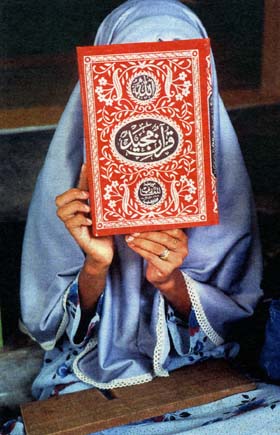
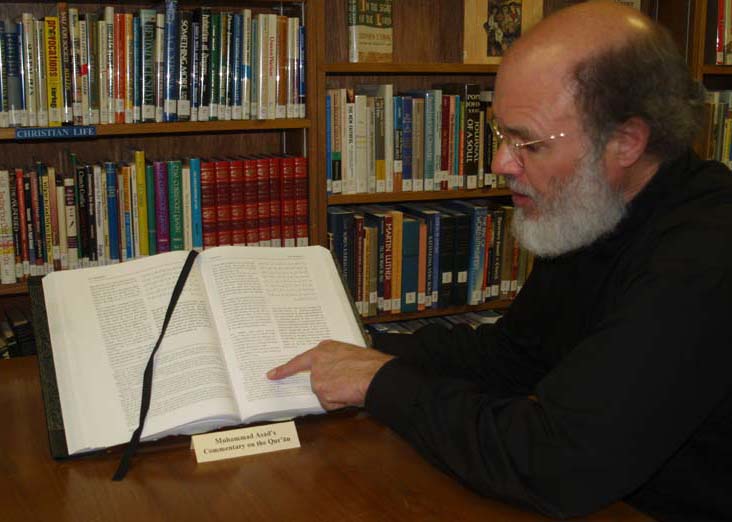
Reading the Koran With Pastor Marshall The
Class Pastor
Marshall offers this class on the Koran four times a year – usually in
January, April, June and October. It meets on the four Thursdays in each
month from 7-9 pm. Each of the four sessions discuss some 50 verses from
the Koran – sizing them up from a Christian point of view – noting
either their congruence or incongruence with historic Christian
teachings. In
session I surahs (or chapters) 1-7 are discussed, surahs 8-21 in session
II, surahs 22-40 in session III, and surahs 41-114 in session IV. Note
that the surahs are arranged in the Koran with the longest ones first. The
purpose of this class is to become familiar with the contents of the
Koran. It is not a class on the history of Islam. Nor is it a class on
the interpretation of the Koran in its original Arabic text. There are
three approved English translations of the Koran. We use the 1930
edition by M. M. Pickthall. The
class tuition is $50.00. This includes your own copy of the Pickthall
translation of the Koran, study sheets on the selected verses and many
handouts on features of the Koran to enrich your reading. Some of those
handouts provide information from the magnificent international five
volume commentary, The Encyclopaedia of the Qur’an,
edited by J. D. McAuliffe. Others include Martin Luther's preface
to the 1543 Latin edition of the Koran and Melanchthon's
"warning" published in the same volume.
The
Teacher Pastor Marshall has been a Lutheran pastor (ELCA) since 1979. He is married to Dr. Jane L. Harty and they have three children, Susannah, Ruth and Anders. Pastor Marshall graduated from Washington State University in 1971, magna cum laude, with a BA in Philosophy. Upon graduation he was elected into the prestigious academic fraternity, Phi Beta Kappa. In 1975 he graduated from Luther Seminary, St. Paul, MN, with a Masters of Divinity degree. While at Luther Seminary he published his first academic article, "God and Worship." In 1978 he received a Masters in Religion degree from Claremont Graduate School and was advanced into the PhD program. That same year he published his first academic article on Martin Luther, "Luther's Two-Factor Hermeneutic." He then began writing his PhD dissertation on the philosophies of religion in Wittgenstein and Whitehead, but never finished it. Pastor
Marshall has published over 50 articles in academic journals and
professional magazines, specializing in the thought of Martin Luther
(1483-1546) and Søren Kierkegaard (1813-1855). His essays have appeared
in Touchstone, The International Kierkegaard Commentary, The Christian Ministry, dialog, The Ecumenist, Søren
Kierkegaard Newsletter,
Currents in Theology & Mission, Trinity Review, Pro
Ecclesia, Lutheran Quarterly, Lutheran Partners, The
Bride of Christ, Lutheran Commentator, Logia, Lutheran
Forum and Word
& World. In
2003 he published his acclaimed pamphlet, Making a New World: How
Lutherans Read the Bible. While
at Claremont Graduate School, Pastor Marshall was a research assistant
for Professor John A. Hutchinson, author of
Paths of Faith (1969, 1991, 4th ed.) and Living
Options in World Philosophy
(1977) – for which Pastor Marshall worked on the index. His
doctoral advisor was Professor John B. Cobb, Jr., author of many books,
including Beyond Dialogue: Toward a Mutual Transformation of
Christianity and Buddhism (1982) and Transforming Christianity and the World
(1999). Pastor Marshall
studied Islam and the Koran with Jamil Razzak and Abdul Mohammad from
the Idriss Mosque in Seattle, Pastor Marshall is
a conservative Lutheran – believing in and practicing the historic
Christian creeds. So he is not a liberal and could not rejoice in Robley
E. Whitson's classic study on world religions: The Coming Convergence
of World Religions (1971,
1992).
Pastor Marshall believes that significant differences exist between the
great religions of the world and that these should not be smoothed over.
Instead they should be respected, studied and understood.
Students' Recommendations "Thank you for an altogether exciting and enjoyable course in reading the Koran. I appreciate that you are a meticulous and careful instructor. But I really appreciate your ability to teach, inform, provoke, uplift, honor, engage, and inspire – all in the same setting! I learned a lot from this course about the Koran, and I learned a lot about the Gospel." (2-3-2007) "What a rich experience and if I may say, it was much more than I had anticipated when I heard of a class on the Koran being taught by a Lutheran pastor in West Seattle. Your breadth and depth of knowledge of the Koran is formidable and I pray that opportunities for you to sit down and discuss with both Christians and Muslims will increase in the days ahead. I also appreciate your example of faith in word and practice." (2-4-2007) "I have learned a good bit, though I know my knowledge to be meager. Thank you for taking ownership of offering the class. I do believe it is valuable, particularly in these times." (6-26-2008) "I compliment you on your years of study – years of questioning and researching and dialoging with the local Muslim masters. I found the class to be challenging as well as enlightening. And even though I am smarter than I was four weeks ago, I still have a long way to go. However, you have given me a grand beginning." (6-27-2008) "Thanks for listening and allowing me to speak unhindered in class. It's unbelievable how much you were able to get across to us in class in an often humorous but always totally focused way. I sensed a deep commitment in you to honestly help us understand the Koran. The background materials you provided were equally valuable, representing many different views that I would never have known how to gather on my own." (2-1-2010) "Thanks so much for the Koran course. I can't imagine spending the amount of time you have on the project, but you are to be congratulated for wringing those secrets out of the book. You have a fine teaching style, covering an enormous amount of material in such a short time span." (7-30-2011) "I found Pastor Marshall's guidance as a teacher helpful because the Koran can appear contradictory. He has Muslim religious leaders as friends, and strong convictions of his own personal beliefs. He teaches in a spirit of discovery and respect for both Islam and Christianity – with his style of charm and occasional humor. In class he tries to build bridges between two religions that are not the same by exposing and respecting the differences. I certainly feel he did this well. I enjoyed the class." (4-9-2012) "I enjoyed the class very much. In addition to the value of learning some of the fundamentals of Islam, it helped deepen my understanding of Christianity as well – much like taking a foreign language can help one better understand one's own language. I appreciate you sharing your impressive knowledge." (7-27-2012) "Once again, I absolutely loved the class! I learned a lot, even though I was taking it for the second time. And I would like to take it a third time and bring some friends along with me. I simply cannot believe, based on current world events, that this is not the most popular class in Seattle!" (4-26-2013) "This class gave me a whole different view of Islam. I liked that Pastor Marshall answered all my questions and took time to explain even the smallest details. President Obama should take this class! Now that I've taken it, I can talk to people about Islam. And I can explain to other Christians who Allah is." (7-18-2013, by a 5th grader) "Now I can begin. Begin to see linkages between Islam, Judaism, and Christianity. Begin to hear places of similarity and also of difference in our sacred texts and teaching. Begin to feel the heartbeat of the culture of my Muslim neighbors. Pastor Marshall is humble about the limits of his class, scrupulous in scholarly balance, delighted by the complexity of this material, generous in allowing students to grapple. He opens the door wide to make it easy to begin. He sends us out with paths for future learning. And, perhaps most important, he prepares us to talk with Muslims about the Koran with greater respect and curiosity, deepening the authenticity of our connection." (5-1-2014) "Pastor Marshall's class met and exceeded all my expectations. A first rate scholar with as keen a mind as anyone I know, he provided our class with an immersive learning experience that was inspiring, challenging, and engaging. Anyone with a desire to learn the basic teachings of Islam and the Qur'an would be wise to sign up for this class pronto. I recommend it wholeheartedly." (3-9-2015) "I appreciate all your handouts. As a visual learner I'm grateful for all the paper resources that I can go back through over time and really dig into more deeply, as well as share with others. Thank you for all the time and effort you have clearly put into this class. May it indeed lead to deeper understanding and peace between Muslims and Christians." (7-31-2015) "What a great class. My wife and I were both glad we took it. Very enlightening! And your mullahs were right about not understanding the Qur'an if we just tried to read it on our own." (7-28-2016) "I truly enjoyed the class even though I labored hard through some of it. I genuinely believe that this course would benefit anyone seeking to better understand global events and US policies. It would also particularly benefit anyone working in education, social services, medicine, law enforcement, or any form of public service. Thanks for having the heart and the vision to delve into the Qur'an and teach it so effectively." (8-1-2016) "This has been an exceptional learning experience! You are an inspiring teacher and leader. I appreciated the design of the course and the materials provided. This course strengthened my faith and enhanced my daily Bible study as I came across Scripture that was referred to in the Koran. I looked forward to class each week and finding out what was next. Now I'm looking forward to sharing what I've learned with my Muslim friends." (7-19-2018) "Thanks for your very stimulating, thoughtful, well-organized, educational, balanced [Q42:17] January journey through the Koran. Whew! We made it thanks to you." (1-26-2021) "I so appreciate your willingness to continue to teach the Koran! It's especially important for us to understand and respect the beliefs of others as best we can, just as it is to understand other religious philosophies." (3-5-2021) "Please know how much I appreciated your approach and effort in your wonderful class on the Koran. What you're doing is notable and a little rare – taking the reader to the primary documents of the faith rather than beginning with summaries. Too often we talk about a topic instead of looking at what is actually there. Imagine discussing the role of Picasso in modern art without ever looking at his paintings! It's my intent to sit in on your class again when I can devote the time even more seriously than I did the first time through. Blessings on your ministry." (7-17-2021) Signing-Up for
the Class If
you are interested in this class contact Pastor Marshall by email deogloria@foxinternet.com
or by telephone 206-935-6530.
Saturday Workshops Pastor Marshall also offers, by special arrangement, one day abbreviated versions of his class. These are held on Saturdays from 9 am to 4 pm. The cost is $20 per person, with a minimum enrollment of 20 persons. Lunch is provided.
A HALF-HOUR VIDEO INTERVIEWING Pastor Marshall about his Koran Class has been posted on the West Seattle Blog. Check it out at http://westseattleblog.com/2017/06/video-first-lutheran-church-of-west-seattle-pastor-ron-marshalls-quran-class-still-going-strong/ |
||||
|
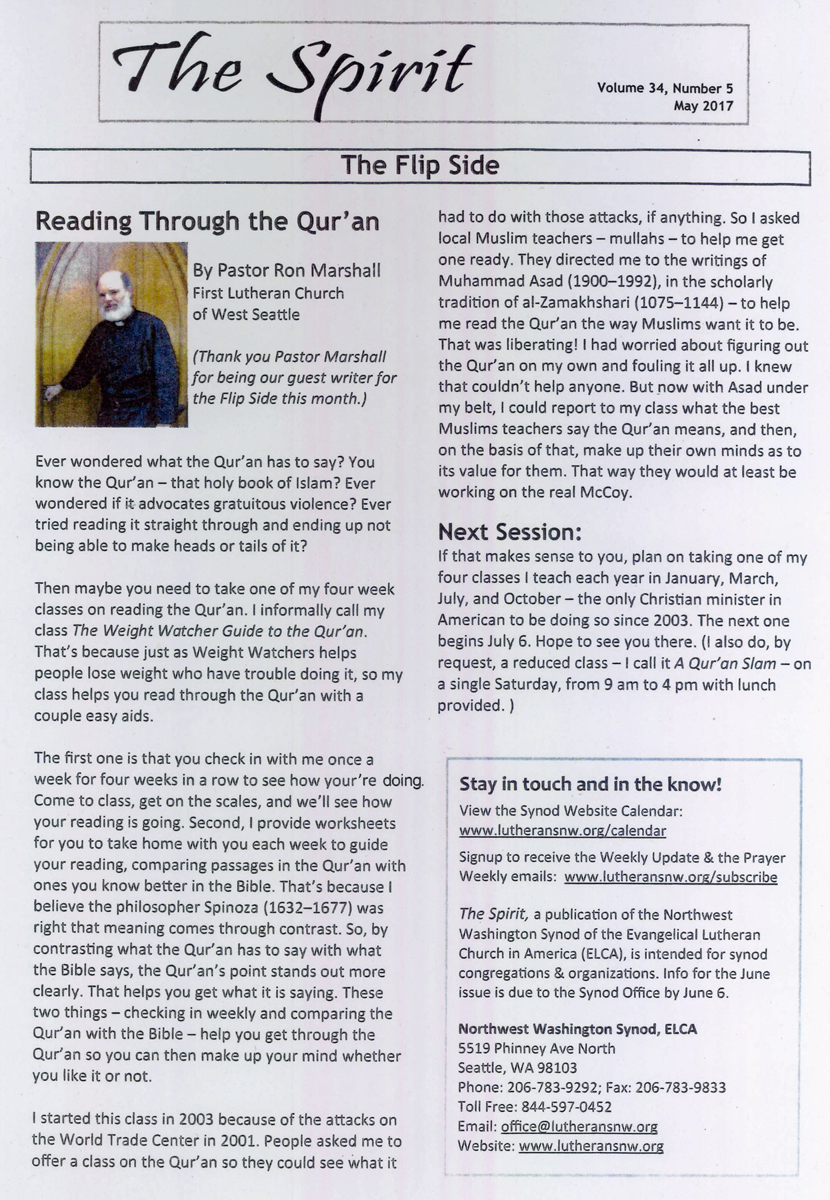
TEACHING THE QUR'AN HELPS UNDERSTAND MUSLIMS
By the Rev. Ronald F. Marshall
|
||||