|

Burying
a Demitted Christian
By
Pastor Marshall
When my father died my
family did not know how to bury him.
He had demitted the Christian faith some thirty years earlier
and naturally did not want a church funeral.
His wife and children, however, wanted to gather as
Christians for prayers – giving thanks for the good and lamenting
the bad. The problem was
we did not have a liturgy for this.
The pertinent rubric for the burial of the dead in the Lutheran
Book of Worship said by “certain omissions and choices of
alternative selections this service may be adapted for.... people
having no connection with the Church.”1
This meant what we were looking for should be possible.
The problem, however, remained:
Which omissions and choices would we make?
No concrete liturgical proposals were available to guide us.2
What follows is the liturgy I wrote with minor changes made
by my family. I offer it
as a model for anyone facing a situation like ours.
We used this liturgy at the new national cemetery in
Kent
,
Washington
, where my father’s cremated remains were inurned with full
military honors.
In addition to our liturgical problem we also had a massive
theological one. We were
tempted to lie and say my father was a Christian when we knew he was
not. By telling this lie
we could then bury him in the church with the standard burial
liturgy. We could then
say he was at peace. We
would no longer have to fear he had gone from the frying pan into
the fire. Neither would
we sound judgmental.3
All of this tempted us to lie.
In the end we resisted this temptation as the liturgy below
shows.
A major reason for this was my father’s well known disdain
for Christianity. He
frequently and eloquently said how much he hated the Church and
despised the Bible. His
repartee on these matters was legendary and imposing!
He regularly ridiculed Christians for their beliefs and
practices. He was a true
unbeliever. He studied
and practiced Christianity for years and finally rejected it.
He had no regrets.
One reason this lie was to tempting was it made God look
better. We could then
say God’s love was so great that it even saves unbelievers!4
Then we would no longer have to endure Luther’s dark view
that “God himself cannot give heaven to him who does not believe.”5 But
Holy Scriptures would not grant our wishes.
Salvation must come “through faith” (Ephesians 2.8).
Furthermore God creates both weal and woe (Isaiah 45:7).6
He has a hard side which includes sending unbelievers to
hell. Indeed “he who
does not believe God has made him a liar, because he has not
believed in the testimony that God has borne to his Son.
And this is the testimony, that God gave us eternal life, and
this life is in the Son. He
who has the Son has life, he who has not the Son of God has not life”
(1 John 5:10-11). This
is true even if the one on the short end of the stick is your
father.7
This lie further tempted us into hoping a trace of faith
remained that saved him. Maybe
a little faith still clung to the inside of his heart even after he
hardened it against Christ Jesus and demitted the faith! Or
maybe just as he died he started believing again.
These ideas raced around in our heads.
But they finally could not stand up against Biblical
teaching. Faith is more
muscular than that. It
is a “good fight” (1 Timothy 6:12).
It bears fruit and even “moves mountains” (Matthew
17:20). It has visible
manifestations. It
therefore does not “float on the heart like a goose on the water,”
as Luther mused. Rather
it is “vigorous and powerful,” even to the point of making “an
altogether new human being” by fashioning “a different mind and
different attitude.”8
This never even came close to happening for my father, as all
who knew him testify. He
had no Christian devotion. He
repeatedly and unrepentantly violated his marriage vows and reneged
on his parental obligations.
Some also wondered if my father was saved from hell by my
mother’s faith. But
this is a misunderstanding of 1 Corinthians 7:12-16 which only holds
hope for unbelieving husbands before they die.
The truth is there are no “second-hand” Christians.9
This is because everyone “must fight his own battle with
death by himself, alone.... Therefore every one must himself know
and be armed with the chief things which concern a Christian.”10
My family laments that to all appearances my father was not
so armed. He was an
excellent soldier but against the “last enemy” (1 Corinthians
15:26) he was willingly and foolishly defenseless.
He did not believe that “only when we take hold of
Christ... and believe that for his sake God is gracious to us” are
we rescued “from the jaws of hell.”11
Christians need to know what to say and pray when such people
die.
The
Memorial Liturgy12
L
In the name of God the Father, Son X
and Holy Spirit.
C
Amen.
L
The Lord be with you.
C
And also with you.
L
Let us pray: Heavenly
Father, you have authority over life and death, being God of the
spirits and Master of all flesh; you kill and make alive, you bring
down to the gates of hell and bring up to the glories of heaven; you
create the spirits of mortals within them and take to yourself the
souls of the saints and give rest.
Console us now who mourn the death of Robert Marshall; grant
to us all a good end, through your only Son, Jesus Christ our Lord.13
C
Amen.
Obituary14
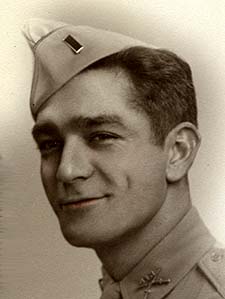
Robert Irwin Marshall was born the fourth of five children to
Frederick William and Nellie Morris Marshall on May 28, 1918, in
Rochester
,
New York
. He died in his home in
Tacoma
,
Washington
, on May 22, 1998.
Robert was baptized as a young child at the
Clinton
Avenue
Baptist
Church
in
Newark
,
New Jersey
. He stayed in public
school until the age of 16 when he went to work for the Jiffy
Manufacturing Company in
Hillside
,
New Jersey
. On January 8, 1940 he
joined the US Army.
On October 10, 1943 he married Eva R. Lien at
Grace
Lutheran
Church
in
Corvallis
,
Oregon
, with the Rev. Lael H. Westberg officiating.
Their marriage was blessed with four children: Doreen Marie
in 1946, Ronald Frederick in 1948, Richard Harry in 1956 and Denise
Ann in 1958. He also
became the grandfather of eleven and the great-grandfather of two.
In June 1944 he left with the 96th Infantry
Division to fight in WW II in the Philippine Islands.
There he was awarded the Bronze Star for bravery.
In April 1945 he entered the battle of
Okinawa
. On Sugar Loaf Hill he
received a second Bronze Star for bravery and the Silver Star for
gallantry in action. On
May 12, 1945, he was wounded on
Conicle
Peak
and awarded the Purple Heart. After
recovering from his injury he returned to Eva and her family in
Missoula
,
Montana
, on December 22, 1945.
By the end of 1945 they moved to
New Jersey
where Robert was raised. During
the beginning of that year he received confirmation instruction from
the Rev. Ralph Tellefsen and on April 16, 1946, joined
Bethlehem
Lutheran
Church
in
Elizabeth
,
New Jersey
. He attended church for
some twenty years after that, then quit and never returned.
In November 1951 he was promoted to the
rank of Captain and left to fight in the Korean War as commander of
F Company in the 2nd Infantry Division.
In March 1952 he was wounded in Wejambu and awarded his
second Purple Heart. After
recovering from his injury he was back with Eva in
Great Falls
,
Montana
, by 1953, where he remarried her on March 12 at Our Savior’s
Lutheran
Church
with the Rev. Griffith H. Williams officiating – after having been
divorced from her on March 15, 1951.
On September 25, 1957 Robert retired from the US Army in
Tacoma
,
Washington
. Twenty years later he
left Eva and in 1980 moved to
Angeles
City
in the Philippine Islands, where he lived until 1990.
Shortly after beginning to see her again, there was a family
reunion at the Casa Real Mexican restaurant in
Fife
,
Washington
on July 7, 1992. Then on
March 21, 1997, he was reunited with Eva in their family home in
Tacoma
, ten days after having massive cancer surgery.
There he lived until his death on May 22, 1998, just six days
before his eightieth birthday.
He is survived by his wife Eva, his sister Edna of Hillside,
New Jersey, his four children, his eleven grandchildren, his two
great-grandchildren, and numerous nieces and nephews.
The
Psalm
L
Truly no man can ransom himself or give to God the price of
his life.
C
We shall see that even
the wise die, the fool and the stupid alike must perish and leave
their wealth to others.
L
This is the fate of those who have foolish confidence, the
end of those who are pleased with themselves.
C
But God shall ransom my
soul from the power of death, for he will receive me.
L
Though while a man lives he counts himself happy, and though
he gets praise when he does well for himself, he will go to the
generation of his fathers who will never again see the light.
(Psalm 49:7-19)
L
The Word of the Lord.
C
Thanks be to God.
L
Let us pray: O
Lord our God, King of the Universe, we commend to your care Robert
Marshall, your child by Holy Baptism, whose earthly life has now
ended. We know that
faith in your dear Son, Christ Jesus, is the only way we have to
live with you in heavenly peace and joy.
Our hope is that Robert finally had this faith.
If he did not, give us strength to stand by your righteous
judgment.
C
Amen.
The
Old Testament Lesson
L
I call heaven and earth to witness against you this day.
C
That I have set before you life and death, blessing and
curse.
L
Therefore choose life, that you and your descendants may
live,
C
Loving the Lord your God, obeying his voice, and cleaving to
him. (Deuteronomy
30:19-20)
L
The Word of the Lord.
C
Thanks be to God.
The
Litany
L
Heavenly Father, for our loved one, Robert Marshall, son and
brother, husband, father, grandfather and great-grandfather,
C
We give You thanks.
L
For his intelligence and charm, care and support, conviction
and accomplishments,
C
We give You thanks,
L
For his service in two wars, his courage under fire, his
strength and survival,
C
We give You thanks.
L
From our guilt over failing to commend to him adequately the
life in Christ,
C
Good Lord deliver us.
L
From our guilt over failing to pray for him enough that your
Holy Spirit enter him and soften his hardened heart,
C
Good Lord deliver us.
L
In our anger over his failure to be a good husband,
C
Give us Your peace.
L
In our sadness over his failure to be a good father,
father-in-law, grandfather and great-grandfather,
C
Good Lord comfort us.
L
In our fear that he despised the forgiveness of sins for
Jesus’ sake,
C
Keep us steadfast in
your word.15
The
Gospel
L
For God so loved the world that he gave his only Son, that
whoever believes in him should not perish but have eternal life.
C
For God sent his Son
into the world, not to condemn the word, but that the world might be
saved through him.
L
He who believes in him is not condemned; he who does not
believe is condemned already, because he has not believed in the
name of the only Son of God.
C
And this is the
judgment, that the light has come into the world, and men loved
darkness rather than light, because their deeds were evil.
L
For every one who does evil hates the light, and does not
come to the light, lest his deeds should be exposed.
C
But he who does what is
true comes to the light, that it may be clearly seen that his deeds
have been wrought in God....
L
He who believes in the Son has eternal life; he who does not
obey the Son shall not see life, but the wrath of God rests upon
him. (John 3:16-21, 36)
L
The Word of the Lord.
C
Thanks be to God.
L
Let us pray: From
everlasting death and torment, deliver us, O Lord God.
In that awful day, when the heavens and earth are destroyed
by fire, and you come to judge all that you have made, have pity on
us for Jesus’ sake. Without
your dear Son, dread and trembling seize us when we ponder your
judgment and all-consuming wrath.
On that great and exceedingly bitter day, may our faith hold
fast in Jesus Christ, who died and rose for us.
C
Amen.
The Benediction
L
Now may the God of peace who brought again from the dead our
Lord Jesus, the great shepherd of the sheep, by the blood of the
eternal covenant, equip you with everything good that you may do his
will, working in you that which is pleasing in his sight, through
Jesus Christ; to whom be glory for ever and ever.
(Hebrews 13:20-21)
C
Amen
L
Depart in peace.
C
In the name of Christ X our Lord.
Amen.
ENDNOTES
1Lutheran
Book of Worship: Ministers Desk Edition. (Minneapolis:
Augsburg Publishing House, 1978), p. 37.
2The
Episcopal Church offers a burial liturgy for “One Who Does Not
Profess the Christian Faith” (The
Book of Occasional Services, New York: The Church Hymnal
Corporation, 1979, pp. 156-159).
None of the eight lessons or ten prayers listed, however,
express fear that the deceased was in jeopardy of being damned.
This omission makes this liturgy unusable and its
faithfulness suspect.
3In
“Judging One Another,” Lutheran Commentator 7 (March/April, 1994) 6, I propose six ways to
keep our judgments from being judgmental.
“First our judgment must use no double standard.
What’s good for the goose is good for the gander.
Next our standards for measurement must be more than personal
opinion. God’s will
and command must obtain. Third
our judgment must be revisable, for new information and
circumstances are always relevant.
Fourth our judgment must be corrective instead of vengeful
and mean-spirited. It is
to aim at improving the one judged.
That makes judgment loving.
Fifth it is to be deliberate.
Snap judgments about people are always poor.
Instead we should strive for balance and thoroughness.
And sixth our judgment should be communal.
This is the burden of the teaching in Matthew 18:15-20 and 1
Corinthians 5:1-13. We
must seek corroboration.”
4A
clear statement of this view is Jacques Ellul,
What I Believe, translated by Geoffrey W. Bromiley (Grand
Rapids: Eerdmans, 1989), “How can we think that God can cease to
love the creation that he has made in his own image?
This would be a contradiction in terms.
God cannot cease to love.... It is unthinkable that there
should exist a place of suffering, of torment, of the domination of
evil, of beings that merely hate since their only function is to
torture. It is
astounding that Christian theology should not have seen at a glance
how impossible this idea is. Being
love, God cannot send to hell the creation.
This would be to cut off himself” (p. 190).
Unfortunately Ellul never considers Mark 9:48 where Jesus
says the unrighteous will go to hell where the “worm does not die
and the fire is not quenched.”
At that point “I have reached bedrock, and my spade is
turned,” to borrow a line from Wittgenstein [Philosophical Investigations, (1958) §217], which means we cannot
think any further, hoping thereby to undermine or change what this
verse clearly concludes.
5Martin Luther, Defense and
Explanation of All the Articles (1520), Luther’s
Works 32:76.
6On this dual nature of God
see my “Duplex Verba,” Pro
Ecclesia 3 (Fall, 1994) 395-396.
7Neither
could the fact he was baptized guarantee him salvation.
In the Large Catechism (1529), Luther shows how baptism degenerates into
an “unfruitful sign” (LC 4,73) when there is no faith to go with
it. In these cases one
has been “baptized in vain” [Lectures on Hebrews (1518), Luther’s
Works 29:138]. On
this catastrophe see my “Poisoning Baptism,” The
Bride of Christ (Lent-Easter, 1991) 9-13.
8Martin
Luther, Lectures on Genesis 6-14 (1535), Luther’s
Works 2:266.
9See
Søren Kierkegaard’s
Journals & Papers, translated and edited by Edna H. and
Howard V. Hong, in 7 volumes. (Bloomington:
Indiana University Press, 1967-78), §1441.
“A second-hand relationship to God is just as impossible
and just as nonsensical as falling in love at second-hand...”
10Martin
Luther, The First Sermon, Invocavit Sunday (March 9, 1522), Luther’s
Works 51:70.
11The
Book of
Concord
: The Confessions of the
Evangelical
Lutheran
Church
, (1580), translated and
edited by Theodore G. Tappert, (Philadelphia: Fortress, 1959) pp.
138, 414.
12The
italicized paragraphs and lines were read by those in attendance.
I read the rest.
13This
prayer is adapted from the “Prayer Book of Serapion, Bishop of
Thmuis in the first half of the fourth century” [Philip H.
Pfatteicher, Commentary on the
Lutheran Book of Worship, (Minneapolis: Augsburg, 1990) p. 479].
14Some
think obituaries have no place in burial liturgies.
If they function to draw attention away from God and glorify
the deceased, then I agree. Indeed,
how can we believe if we “do not seek the glory that comes from
the only God?” (John 5:44) In
this liturgy, however, the intent was to show how my father had “drifted
away from.... such a great salvation” (Hebrews 2:1-3).
When the obituary tries to expose the faith and works (James
2:17) of the deceased, then it belongs in the liturgy.
When Christians bury a demitted Christian, Matthew 7:16,
“You will know them by their fruits,” requires that an
obituary is included in the liturgy.
15This
litany was the most controversial part of the liturgy.
One grandchild said it was mean-spirited and “trashed
Grandpa Bob!” But the sequence of the petitions and the
confessional nature of the phrases, “our anger,” “our sadness”
and “our fear,” suggest something quite different.
16This
prayer is adapted from the “twelfth century responsory Libra
me, Domine” (Pfatteicher, Commentary,
p. 479).
(Reprinted
from The Bride of Christ,
September 1998)
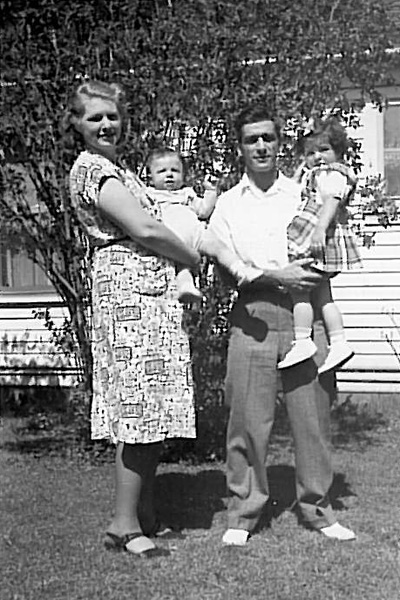
Pastor Marshall, in his mother's arms, on Easter 1949, in Bonner,
Montana. His father is holding his sister Doreen.
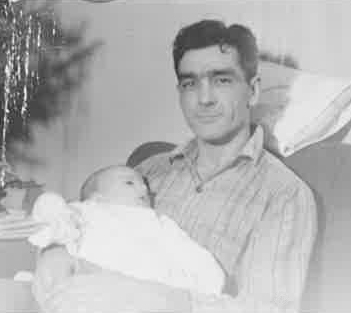
Pastor Marshall in his father's arms at his first Christmas, 1948. |




e.jpg)